The 6-Slide Board Deck I Recommend to Seed-Stage Founders
A lot of VCs think it’s a waste of time to have board meetings at the seed stage. The team should have all their time to build rather than preparing for board meetings. And many VCs feel that it’s not worth investing a lot of time in a startup until it starts to take off – so pre-product/pre-revenue startups don’t get a full slot of VC attention.
I disagree. At Ubiquity, we hold monthly board meetings with our CEOs, including at the pre-seed and seed stage.
Part of the reason is that I want them to rise up to the level of the Series A CEOs they’re aiming to become. Beyond this, it’s also helpful for the team to have forcing function every 30 days to pull up out of the weeds and look at the company, its trajectory, and possible blind spots.
What did you think was going to happen over the last month? What actually happened? What did you learn? What are you changing? And where can your board help?
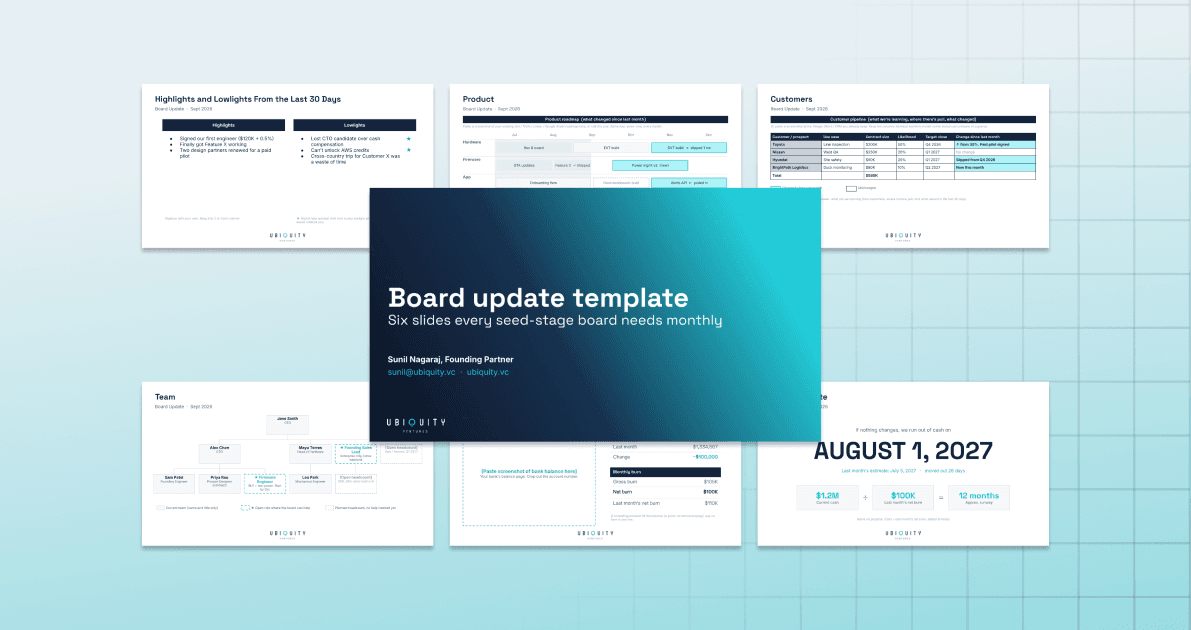
I’ve covered this before in Ubiquity University. One module focuses on nailing the mindset for your first board meeting, including how to avoid the cognitive traps that often trip up pre-seed and seed founders. Another walks through making your first board meeting deck, with a suggested structure and specific slides. I also get asked for the actual template pretty often, so I wanted to put a simple version here that founders can copy and use:
View our 6-slide board meeting template (and make your own copy)At the pre-seed stage, I want this to be as low-effort as possible while preserving the function of monthly reflection. You can cover what matters in about five slides.
The first time you set this up, it may take two or three hours. For subsequent meetings, this deck should take <30 minutes to update mechanically so you can then spend a chunk of time thinking about the highlights and lowlights from the last 30 days.
1. Highlights and lowlights
Start with two or three highlights and lowlights from the last 30 days. And on the lowlights, I want the real stuff. I’ve been in plenty of board meetings where these are pretty flimsy or superficial.
Remember, you already have our money. You’re not trying to impress us anymore. If something went badly, tell us. What are you worried about? What can we help unblock? That’s often where the board can be most useful.
Your board is a group of smart, well-connected people who are incentivized to help you. They have networks and experience that can help unblock things. But they can only help with the problems they know about.
If you lost the CTO candidate you wanted because of cash compensation, put that down. If an important customer trip was a waste of time, put that down. If you can’t get your AWS credits unlocked, put that down.
The best CEOs can be at least as negative as their board members about the bad parts of the business. It gives the board confidence that the CEO is looking at the company critically rather than trying to sell them on it.
2. Product and customers
At this stage, the company is primarily a team hunting for product-market fit. I want to see what changed in the last 30 days.
What did you think you were going to build? What are you building now? Did something take longer than expected? Did a feature move up because customers keep asking for it? Did something you thought was important turn out to matter less?
This is where showing the diff, what changed from last month to this month, is really helpful.
Put last month’s product roadmap next to this month’s. What moved forward? What got pushed back? Maybe something was harder to build than you thought. Maybe you learned something from a customer. Maybe you need another engineer.
Do the same with customers. Maybe it’s a customer heat map showing where you’re seeing the most enthusiasm. Maybe it’s a pipeline with the customer, use case, opportunity size, likelihood and target close date. Or maybe it’s literally a screenshot of the Google Sheet you’re already using to track leads.
Ideally, you’re not creating something new for the board. Show me what you’re already using and what changed.
3. Team
This slide can be extremely simple. It’s also one I’ve added since I first made the Ubiquity University board deck template.
Put everyone on the team in a box with their name and title. Then add dotted boxes for the roles you’re trying to hire.
Now the board can see exactly where you need help. If you need a firmware engineer, a sales leader or someone with a very specific technical background, they can start thinking about who they know.
4. Cash
For the most part, I’m fine with a screenshot of your bank balance. I’ve seen a lot of early-stage startups get tripped up or delayed by waiting for monthly or quarterly financials from their accountants.
Show how much cash you have, how much you spent over the last month (“gross burn”), and how that compares to the month before. It doesn’t have to be too fancy. At this stage, I mostly want to know: How much cash do we have? How quickly are we using it? And when do we need to start raising again?
5. Cash-out date
Take the current cash balance and divide it by roughly what you burned last month. This is intentionally a pretty naive calculation. Obviously your burn can change as you hire, start bringing in revenue, or have other expenses. Eg, let’s say you have $1M of cash and a gross monthly burn of $100K, so cash out = $1M / $100K = 10 months from now.
What I want at this stage is a quick sense of when the cash runs out. And I prefer showing that as an actual date.
Don’t just tell me you have 12 months of runway. Tell me the cash-out date is July 1, 2027. I find the date more useful because you can stare at it, work backward from it, and see how it moves from one board meeting to the next.
As the company grows, the financial reporting can get more sophisticated. I recently shared the waterfall method Esper CEO Yadhu Gopalan uses for board updates, which tracks the original board plan alongside actual results and updated forecasts. For a pre-seed company, though, I’d start with the simple version in this template.
Keep the deck the same every month
Use the same slides, terms and layout each month, and show the diff from the prior month. That way the board can quickly see what moved, and you can spend less time updating the deck.
And don’t spend the whole meeting walking through slides. I tell founders that the “real” board meeting happens after the slides are done. If you have an hour, aim to get through the deck in about 45 minutes and save the last 15 for an open conversation: What are you worried about? What am I worried about? Where can the board help?
Spend less time making the deck look good and more time thinking honestly about what changed in the last 30 days.
