Free Financial Model Template for Early-Stage Startups, Updated for 2026
A few years ago, I was in a board meeting for a company that, according to the previous month’s financial update, had eight months of runway left.
Forty-five minutes into the meeting, on the last slide, the team mentioned they were actually going to run out of cash in three months.
Three months! I usually sound the alarm about fundraising when we have six months left.
I asked what happened. They said their accountant had sent updated numbers. Okay, but why did that take us from eight months to three? We kept digging and eventually figured out that they had downloaded a financial model template from a well-known large VC firm and weren’t using one of the tabs of the large model correctly.
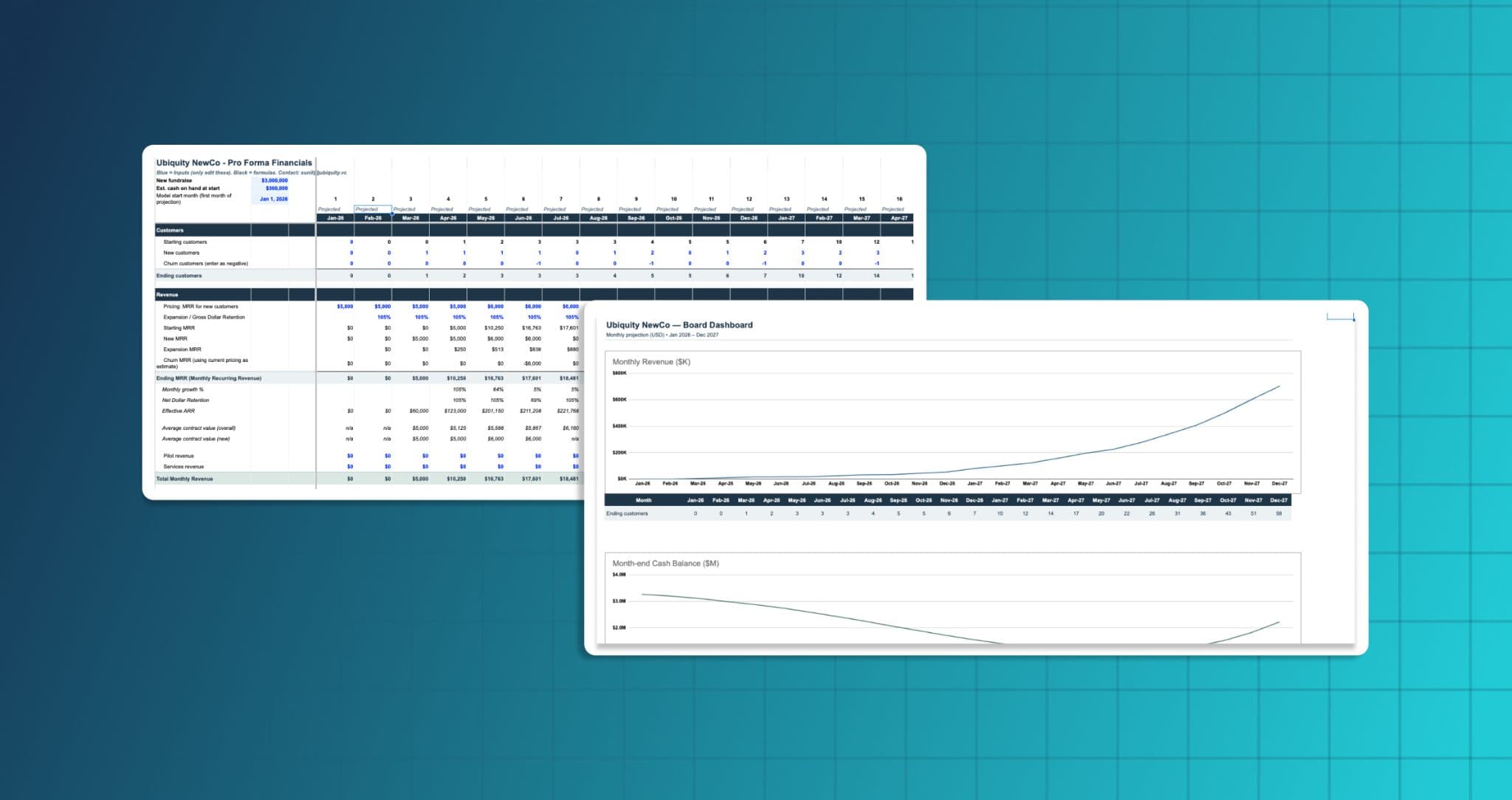
That meeting is why I built the Ubiquity financial model template, which I first shared through Ubiquity University in 2023. We just refreshed it for 2026 with updated assumptions, clearer instructions, and a dashboard showing monthly revenue, customers, cash balance and team size. It’s designed to be light enough for early-stage startups and useful through your first 1–3 years.
If you’re a founder, or work with early-stage founders, feel free to use and share this template. I built it specifically for pre-seed and seed-stage companies, when you really just need a simple way to understand your cash, burn and runway.
Download the template hereIf you want some help getting started, there’s also a 17-minute no-experience-required walkthrough on Ubiquity University. I recorded it with the original version of the template, but the basic approach is the same.
The case for a skinny model
At the pre-seed and seed stage, I don’t think you need a huge financial model with a bunch of tabs nobody understands. You need to know how much cash you have, how much you’re burning and when you’re going to run out.
So this model is deliberately simple. It’s a combination of cash accounting, accrual accounting, SaaS and hardware because that’s what our founders actually need. The point is that you should understand what every number means and where it came from.
And when you don’t, ask!
Two other founder templates
A lot of Ubiquity University has started this way. I have a pet peeve, usually because I’ve seen the same problem a few too many times, and eventually I decide we should just make something that helps founders do it better.
We’ve made a couple of other templates available too:
- Board deck template: A six-slide monthly board update that makes it easy to see what changed and where you need help.
- ARR waterfall: A simple way to track new, expansion and churned revenue month over month.
If there’s another founder template you wish existed, send your ideas my way!
